AFS_UISpace_Pawn
Body-locked spatial UI positioned from data assets, with element pooling and a keyboard anchor for text entry.
What it gives you
- UI that follows the player rather than the world
- Position presets as data assets
- Element pooling so panels are reused, not respawned
Requires
Required by
Description
Spatial UI in VR has to decide what it is anchored to. AFS_UISpace_Pawn anchors to the player's
body: panels sit at a defined distance and angle and follow as the player moves, without being
rigidly locked to head rotation, which is uncomfortable.
Positions are PDA_PawnUIPosition data assets rather than hard-coded offsets, so a project can
define its own near, mid and far placements once and reuse them. Elements are pooled rather than
spawned and destroyed, and the component ticks at 0.5 s because body-locked UI does not need
per-frame updates.
Setup
- Enable
AFS_UISpace_Pawn. - Add
BPC_PawnAbility_PawnUIto the pawn. - Create or pick a
PDA_PawnUIPositionfor the placement you want.
Usage
Showing a widget
Call AddWidget on the component with your widget class and a position data asset. BFL_Popups does
exactly this internally.
Defining a position
Duplicate a shipped PDA_PawnUIPosition and adjust distance, height and angle.
Key properties
| Property | When to change |
|---|---|
| Position data asset | Distance, height and angle of the panel |
| Tick interval | Lower only if panels visibly lag; the 0.5 s default is deliberate |
Extending
Create your own PDA_PawnUIPosition assets. For different anchoring behaviour, derive from BP_Helper_PawnUIPosition.
Performance notes
Elements are pooled. Prefer showing and hiding a widget over adding and removing it, so pooling can do its job.
Example map
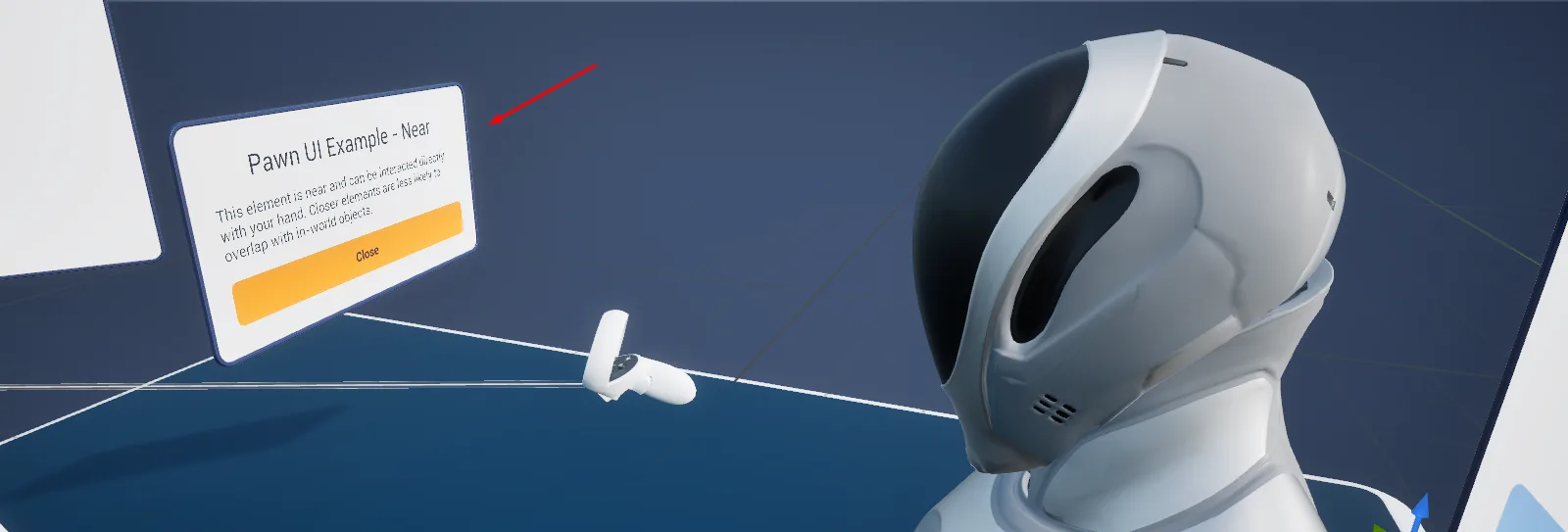
Map_Examples_PawnUI shows panels at two distances.
Troubleshooting
The panel is behind the player. The position data asset's angle is measured from the pawn's forward vector, not the camera's — check which you intended.
API reference
Every blueprint asset in this plugin. Expand an asset to see its members.
Components
BPC_PawnAbility_PawnUI15 members
| Kind | Name | Signature | Description |
|---|---|---|---|
| fn | PositionAllElementsOfPositionPositioning | (Distance: PDA_PawnUIPosition) | Re-seats every open element that shares the given position asset, each one offset by its place in that group so a stack fans out instead of overlapping. Called after any add or removal so the survivors close the gap. |
| fn | getIndexOfElementPositioning | (Element: BP_Helper_PawnUI_Element, out Index: int) | Returns the place an element holds among the other open elements sharing its position asset, which is what decides how far forward it is pushed in the stack. Comes back as -1 when the element is not open. |
| fn | getElementsOfPositionPositioning | (Position: PDA_PawnUIPosition, out FilteredElements: BP_Helper_PawnUI_Element[]) | Returns the open element actors added at the given position asset, in the order they were added. Empty when nothing is currently shown at that position. |
| fn | AddWidgetWidget | (Widget: Class<WBP_Base>, Position: PDA_PawnUIPosition, Pooling: bool, References: Struct_References, out WidgetObject: WBP_Base) | Shows a widget at the given position and returns the widget object. On a VR pawn it spawns, or reuses from the pool, a body-locked element actor, first clearing that position unless the position asset is stackable; on desktop and mobile it hands the work to the HUD component using the position's HUD frame info. Switch on Pooling to keep the actor for reuse. |
| fn | ToggleWidgetWidget | (Widget: Class<WBP_Base>, Position: PDA_PawnUIPosition, References: Struct_References, UsePooling: bool, out WidgetObject: WBP_Base) | Closes the widget class if any instance of it is already open, otherwise adds it at the given position. The widget object is only filled in on the opening pass, so expect it to be empty when the call closed something. |
| fn | RemoveWidget_ClassWidget | (Widget: Class<WBP_Base>) | Closes every open instance of a widget class. On a VR pawn each backing element actor is faded out and either destroyed or returned to the pool; on desktop and mobile the removal is passed to the HUD component. |
| fn | RemoveWidget_ObjectWidget | (Widget: WBP_Base) | Closes one particular widget instance rather than every instance of its class. On a VR pawn the element actor hosting that widget is removed; on desktop and mobile the call is passed to the HUD component. |
| fn | RemoveElementElements | (PlayerUIElement: BP_Helper_PawnUI_Element) | Drops an element actor from the open list, detaches it keeping world transform, refreshes the follow thresholds, fades it out and re-spaces whatever is left at its position. Once the last element goes the body anchor is torn down two seconds later. |
| fn | isWidgetOpen_ClassWidget | (Widget: Class<WBP_Base>, out Open: bool) | Returns whether any instance of a widget class is currently on screen. Answered from the element list on a VR pawn and from the HUD component on desktop and mobile, so it reports on whichever surface the pawn actually uses. |
| fn | isWidgetOpen_ObjectWidget | (Widget: WBP_Base, out Open: bool) | Returns whether one particular widget instance is currently on screen, rather than any instance of its class. Answered from the element list on a VR pawn and from the HUD component on desktop and mobile. |
| fn | getPooledElementElements | (Widgets: Class<WBP_Base>, out Element: BP_Helper_PawnUI_Element) | Returns the pooled element actor previously built for a widget class, if one is being held for reuse. Comes back empty when nothing has been pooled for that class, which is what tells Add Widget to spawn a fresh element. |
| fn | updateTolerancesPositioning | () | Pushes the tightest location and rotation thresholds found across the open elements' position assets onto the body anchor, so the anchor follows the player as closely as the fussiest open panel wants. Run with nothing open it leaves the anchor on a threshold of 100000, which effectively stops it following at all. |
| event | WidgetCommand | (Command: name, Payload: ST_GenericPayload) | Relays a named command and its payload straight out through On Widget Command. Use it as the hook for widget features that have to travel over the network, rather than calling into the widget object directly. |
| event | SetPositionHelper | (Set: bool) | Spawns the body anchor that elements are positioned against, seeds its thresholds and subscribes to its repositioned delegate; a second call with true does nothing while an anchor already exists. Passing false starts a retriggerable two second delay and then destroys the anchor, but only if no element has appeared meanwhile. |
| event | OnRepositioned_Event | () | Internal handler called by the body anchor each time it has moved to catch up with the player. Re-seats every open element against the anchor's new transform. |
DataAssets/Keyboard
BP_KeyboardLocation_PawnUI2 members
| Kind | Name | Signature | Description |
|---|---|---|---|
| fn | CreateKeyboard | (Pawn: Pawn, KeyboardClass: Class<WBP_Keyboard>, ExtensionClass: Class<WBP_Keyboard_Extension>, KeyBoardSizeMultiplier: float = 0, CloseOnEnter: bool = false, TextBoxWidget: Widget, InputWidget: WBP_TextField, WidgetInteractionComponent: WidgetInteractionComponent, out Keyboard: WBP_Keyboard) | Opens the keyboard as a body-locked panel through the pawn's UI component, at the shipped keyboard position, instead of as an overlay on the calling widget. The keyboard is bound to the text field being edited and its window is made non-focusable so typing does not pull focus off that field; a pawn without the pawn UI component gets no keyboard at all. |
| fn | OnOverlayClosed | (Overlay: BP_Overlay) | Internal handler that broadcasts Keyboard Closed when an overlay hosting the keyboard reports it has shut. Nothing binds it in this location, as the keyboard here is a body-locked panel rather than an overlay. |
DataAssets/Positions
PDA_PawnUIPosition0 members
No editor-visible members; this asset configures defaults only.
Helper
BP_Helper_PawnUIPosition7 members
| Kind | Name | Signature | Description |
|---|---|---|---|
| var | PawnEssentials | Pawn | The pawn this anchor follows. Its camera component supplies the location and yaw the anchor snaps to, so an anchor spawned without one never moves and every panel hanging off it sits at the world origin. |
| var | LocationThreshholdSettings | float | How far the camera may drift from the last anchored position, in centimetres, before the anchor follows it. Spawned at zero and then overwritten by Update Thresholds with the tightest value among the open elements, so a figure set by hand does not survive the next add or removal. |
| var | RotationThreshholdSettings | float | How far the camera's yaw may turn from the last anchored rotation, in degrees, before the anchor turns to follow. Spawned at zero and overwritten by Update Thresholds in the same way as the location threshold. |
| fn | getTransformForAngleAndDistance | (Position: PDA_PawnUIPosition, Index: int, out Transform: Transform) | Returns the world transform an element should sit at for a given position asset, by placing the internal arrow at the asset's distance, height and pitch. Each step up the stack index pulls the element one centimetre nearer the player, and the scale is derived from the distance so a far panel is drawn bigger to stay legible. |
| fn | getReferencePosition | (out Transform: Transform, out RightVector: Vector) | Returns the pawn camera's yaw as a transform, along with the camera's right vector. The location is pinned to the world origin rather than the camera, so treat the transform as orientation only. |
| fn | UpdatePosition | () | Snaps the anchor to the pawn camera's current location and yaw only, ignoring pitch and roll so panels never tilt, records that pose and broadcasts On Repositioned. Runs on begin play; call it yourself to make the panels catch up at once instead of waiting for a threshold to be crossed. |
| fn | UpdateThresholds | (LocationDeltaThreshhold: float, RotationDeltaThreshhold: float) | Overwrites both follow thresholds in one call. Driven by the pawn UI component every time an element is added or removed, so it always wins over values set in the editor or on spawn. |
BP_Helper_PawnUI_Element12 members
| Kind | Name | Signature | Description |
|---|---|---|---|
| var | WidgetProperties | Class<WBP_Base> | Class of widget hosted by this element, created on the widget component the first time the element appears. Also the key the pool matches on, so a later request for the same class can reuse this actor. |
| var | PositionProperties | PDA_PawnUIPosition | Placement asset deciding where the element sits: distance, height, pitch and the thresholds the anchor follows the player with. It also groups the element with the others at the same position for stacking and for clearing a non-stackable slot. |
| var | PlayerUIComponentProperties | BPC_PawnAbility_PawnUI | The pawn UI component that spawned this element, called back when the hosted widget asks to close. Leave it empty and the widget's close request goes nowhere, stranding the element on screen. |
| var | ReferencesReferences | Struct_References | Reference struct resolved into the widget at the moment its class is created, giving it the objects it is meant to show. Leave empty for widgets that need no context. |
| var | PoolingPooling | bool | Whether the element survives removal instead of being destroyed. A pooled element is hidden and kept in the component's pool for the next request for the same widget class, which saves a respawn at the cost of holding the widget in memory. |
| fn | getRelativeTransform | () → Transform | Returns the element's transform relative to the actor it is attached to, falling back to its world transform when it is attached to nothing. Elements are detached as they are removed, so from that point it reports world space. |
| fn | getDesiredWidth | (out Width: float) | Returns the width this element would like to be allotted when panels are laid out beside each other. The body is a stub that always answers zero; override it in a derived element if your layout needs a real figure. |
| event | Disappear | () | Shrinks the element away, hides the widget and unregisters it from the replicated UI stand-in shown to other clients. A pooled element stops there and waits to be reused; an unpooled one first arms the fade handler that destroys it once the fade has run out. |
| event | SpawnScale | (Set: bool) | Plays the 0.6 second scale curve forwards to grow the panel from a hundredth of its size, or reverses it to shrink away. It also slides the spring arm a few centimetres vertically over 0.3 seconds, which is what gives the panel its lift as it opens. |
| event | Appear | () | Grows the panel in, creates the widget from the stored class if it does not exist yet, makes it visible and registers it for replicated UI. Called by the pawn UI component immediately after the element is spawned or taken from the pool; a pooled element reappears with its widget state intact. |
| event | OnFadeComplete_Destroy | (Visible: bool) | Internal handler bound to the widget component's fade delegate only while an unpooled element is disappearing. Destroys the actor once the fade has finished on the way out, and does nothing when the fade ended visible. |
| event | OnCloseWidgetRequested | () | Called when the hosted widget asks to be closed, whether from its own close button or from any close request raised inside it. Passes the element to the owning pawn UI component's Remove Element, which fades it out and re-spaces the panels left behind. |
Libraries
FL_PawnUI2 members
| Kind | Name | Signature | Description |
|---|---|---|---|
| fn | PawnUI_AddElementPawnUI | (Pawn: Pawn, Widget: Class<WBP_Base>, Position: PDA_PawnUIPosition, Pooling: bool, References: Struct_References, __WorldContext: Object, out WidgetObject: WBP_Base) | Finds the pawn UI component on the given pawn and adds a widget at a position through it, returning the widget object. There is no validity check, so a pawn without the component produces an access-none warning and an empty widget. |
| fn | PawnUI_RemoveElementPawnUI | (Pawn: Pawn, Widget: Class<WBP_Base>, __WorldContext: Object) | Finds the pawn UI component on the given pawn and closes every open instance of a widget class through it. Unchecked in the same way as its counterpart: a pawn without the component gives an access-none warning rather than a quiet no-op. |